
analisa.pt
Public data aggregator and cross-referencing — from public contracts to local indicators
RESEARCH & DEVELOPMENT
4/20/20263 min read
Analisa.pt — Data readability as civic infrastructure
A case study on transforming public data into explorable governance systems
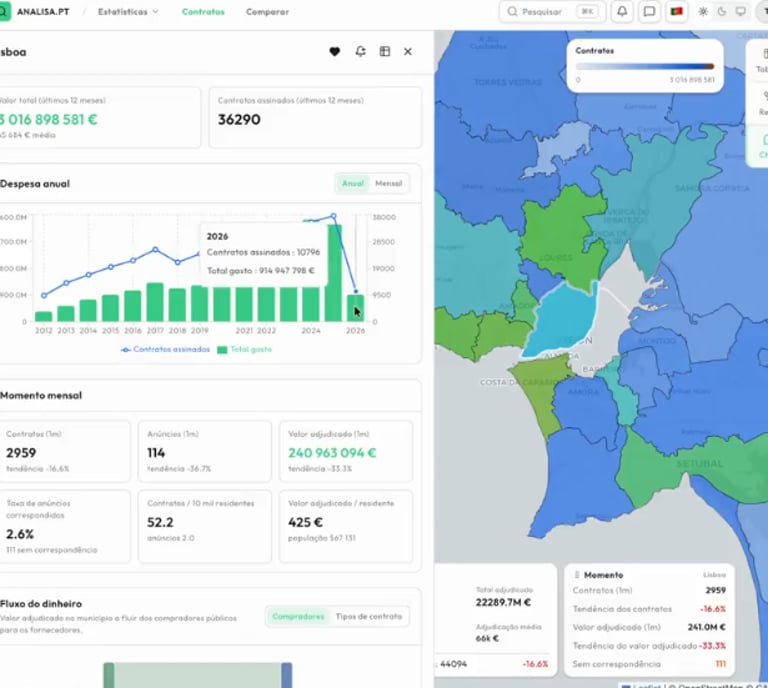
This article analyzes Analisa.pt (https://analisa.pt/) as an object of civic R&D that reframes public data not as an exercise in publication, but as an infrastructure of legibility. Instead of treating transparency as mere availability of information, it explores transparency here as system navigability: the ability to query, cross-reference, and understand the State through structured data interfaces. Analisa.pt is understood not as a tool, but as a prototype of a broader shift in the digital architecture of governance.
The structural problem: data abundance, systemic opacity
Public administrations produce growing volumes of open data. However, this abundance does not translate into effective understanding. Information is dispersed across fragmented portals, heterogeneous formats, and poorly interoperable systems.
The result is a paradoxical condition: data is public, but not cognitively operational. This creates a structural gap between:
the publication of information
and effective access to its meaning
In this gap, transparency becomes formal rather than functional.
The limits of the “open data” model
The dominant open data paradigm assumes that availability equates to transparency. However, availability alone does not guarantee legibility.
Three recurring limitations can be observed:
Fragmentation: data exists in isolation, without semantic integration
Static access: information is designed for download, not exploration
High cognitive friction: analysis requires specialized technical mediation
In practice, this creates a system in which only highly specialized users are able to reconstruct coherence from public data.
Analisa.pt as an architectural shift
Analisa.pt introduces a different hypothesis: public data should be treated as an explorable and interconnected system, rather than as isolated artifacts.
Instead of merely aggregating information into dashboards, the platform organizes data into an interface where it is possible to:
navigate relationships between different datasets
cross economic, territorial, and contractual dimensions
explore indicators in a dynamic and comparative way
This brings the system closer to a queryable model of governance, rather than a simple data repository.
Public procurement, territory, and structural relations
One of the platform’s central axes is the reinterpretation of public contracts as a relational system. Rather than isolated records, contracts are integrated into a structure that allows the analysis of:
relationships between contracting authorities and suppliers
spending patterns over time
institutional dependencies
geographic distribution of public investment
Public procurement thus ceases to be merely an administrative record and becomes a legible topology of public resource allocation.
In parallel, territorial data is presented as comparative surfaces, enabling the analysis of municipalities through multiple normalized indicators.
From dashboards to exploratory systems
Most civic data platforms operate through static dashboards. Analisa.pt shifts this model toward an exploratory logic. The difference is structural:
dashboards respond to predefined questions
exploratory systems allow questions to be formulated in real time
This introduces a fundamental shift:
from data consumption → to active construction of analysis
The user ceases to be an observer and becomes an explorer of relationships between data.
Transparency as system navigability
Analisa.pt’s most significant conceptual contribution is the redefinition of transparency.
Transparency is no longer understood as:
the publication of data
or the formal opening of information
Instead, it becomes the capacity of a public system to be navigated, interrogated, and understood as a coherent structure. In this perspective, transparency ceases to be a property of data and becomes a property of the system’s architecture.
Implications for the design of civic infrastructures
If public systems are increasingly mediated by data, then their design becomes a form of governance architecture.
Analisa.pt suggests three main implications:
Legibility is infrastructural
Understanding the State depends on system design, not only on data publication.Interoperability is a civic capacity
The ability to cross-reference data determines the capacity for public analysis.Exploration replaces publication as the central model
The relationship with data shifts from passive reading to structured interaction.
Conclusion
Analisa.pt should not be understood as a conventional data platform. It should be interpreted as a prototype of civic legibility infrastructure.
Its contribution lies not only in the data it makes available, but in the architectural proposal it represents: the idea that public systems should be designed to be explored and understood, not merely published.
In this sense, the platform is part of a broader transition in digital governance: from transparency as disclosure to transparency as navigable structure.
Backed by Thendor
Testbed and business expansion
Phone
nuno.amiar@umaboaquestao.pt
+351-91-293-1493


Socials
Contacts
Built in the open for the public good. We invite civic innovators, technologists, and policymakers to collaborate and innovate together

