
Reform of the United Nations Security Council
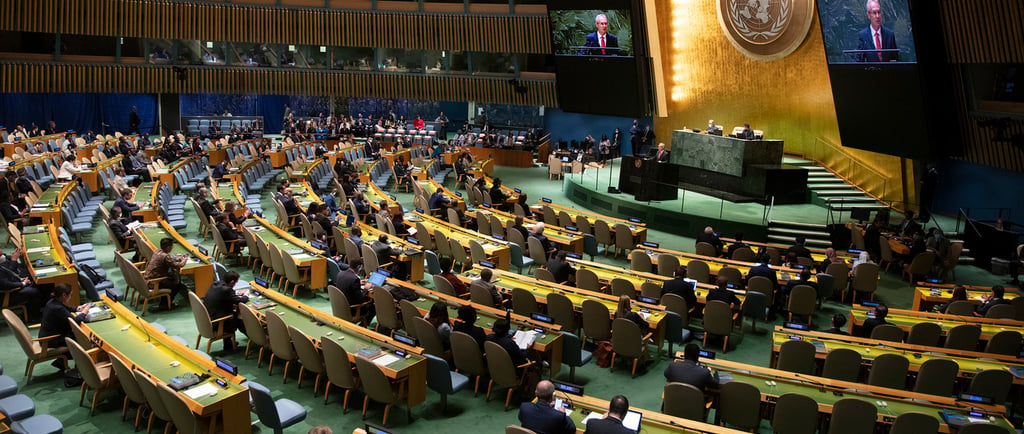
This petition urges Portugal to support reform of the UN Security Council, eliminating veto powers
PETITIONS
5/2/20264 min read
I. Purpose of the Petition
This petition requests that the Assembly of the Republic adopt and promote, within the framework of Portuguese foreign policy and relevant international forums, an official position in favour of the structural reform of the United Nations Security Council, with particular emphasis on the limitation and progressive abolition of the veto power currently held by the permanent members.
II. Statement of Reasons
The United Nations Security Council was conceived in 1945 as the principal body responsible for maintaining international peace and security. Eight decades later, its functioning remains structurally constrained by the veto power granted to five permanent States — a mechanism that allows a minority of countries to block decisions supported by the overwhelming majority of the international community.
This decision-making asymmetry generates institutional paralysis in critical moments, undermining the international community’s capacity to respond to genocides, crimes against humanity, and severe humanitarian crises. The report “Vetoing Humanity”, published by Oxfam in 2024, estimates that between 2014 and 2023 approximately 1.1 million deaths occurred in contexts of prolonged conflict associated with institutional blockages and the recurrent use of the veto.
The United Nations recognizes that the process of Security Council reform has been under continuous intergovernmental negotiation since 2008, without consensus being reached to date. This structural deadlock requires democratic States such as Portugal to adopt clear and active positions in defence of a more just and effective global governance system.
Portugal, as a founding member of the United Nations and a historical advocate of multilateralism and international peace, has a particular responsibility and legitimacy to exert diplomatic pressure in favour of this reform.
III. Factual and Institutional Framework
Reform under negotiation since 2008: The United Nations formally recognizes that the Security Council reform process remains an ongoing intergovernmental negotiation without consensus. Source: https://www.un.org/en/ga/screform/
Documented humanitarian impact: The Oxfam report “Vetoing Humanity” estimates that between 2014 and 2023, 1.1 million deaths occurred in prolonged conflicts associated with inaction or institutional blockage in the Security Council. Source: https://www.oxfam.org.nz/wp-content/uploads/2024/09/bp-vetoing-humanity-190924-en-1-1.pdf
Incompatibility with sovereign equality: The current veto system allows unilateral obstruction of Security Council decisions, regardless of the majority position of the remaining 188 Member States, creating an asymmetry incompatible with the principle of sovereign equality enshrined in the United Nations Charter.
IV. Considerations
Whereas:
a) The principle of sovereign equality of States is a foundational principle of international law;
b) The veto power allows a small number of States to block decisions of global scope;
c) Such a mechanism may prevent effective international responses to serious violations of human rights, genocide, or crimes against humanity;
d) Institutional inaction or blockage contributes to the prolongation and escalation of armed conflicts;
e) The credibility and effectiveness of the United Nations depend on its capacity for timely and representative decision-making;
f) There is growing international recognition of the need for structural reform of the Security Council;
V. We Therefore Request
In light of the above, the petitioners request that the Assembly of the Republic:
Recommend to the Government of the Portuguese Republic that it advocate, within the United Nations and its competent bodies, the progressive limitation and abolition of the veto power in the Security Council;
Promote a Portuguese diplomatic position in favour of the structural reform of the Security Council, based on the principles of equality among States, equitable representation, and decision-making transparency;
Support international initiatives aimed at:
• Eliminating individual blocking mechanisms in international security decisions;
• Strengthening transparency and accountability in the functioning of the Security Council;
• Reinforcing the role of the United Nations General Assembly in scrutinizing situations of institutional blockage;Request from the United Nations Secretary-General, through appropriate diplomatic channels, the preparation of an analytical report on the impact of veto usage on international peace and security, and on the legal and procedural avenues available for amending the Charter.
VI. Legal Principles Invoked
This petition is based on the following general principles of international law:
• The principle of sovereign equality of States (Article 2(1) of the United Nations Charter);
• The principle of international cooperation for the maintenance of peace and security;
• The principle of protection of fundamental human rights and prevention of mass atrocities;
• The Responsibility to Protect (R2P) principle, reaffirmed at the 2005 United Nations World Summit;
Conclusion
The United Nations was born of a promise: that humanity, after the horrors of two world wars, would be capable of governing itself collectively, based on reason, law, and cooperation. That promise is now at risk — not due to a lack of will from the majority, but because of the persistence of a mechanism designed for another world, in another time.
An institution that cannot act in the face of genocide, that silently witnesses atrocities blocked by the veto of a single nation, that has debated reform for more than twenty years without result — such an institution does not merely need to be defended as it is: it must be transformed, or it will face a relevance crisis that has, in many ways, already begun. The question is not whether the United Nations must change. It is whether it will change in time to continue to matter.
Portugal has the opportunity to stand on the right side of history. Not as a country waiting for the consensus of the powerful, but as a voice demanding it — in the name of law, equality, and the conviction that global peace cannot continue to be held hostage by the veto of five.
LINK DO PETITION: https://peticaopublica.com/pview.aspx?pi=PT130927
Backed by Thendor
Testbed and business expansion
Phone
nuno.amiar@umaboaquestao.pt
+351-91-293-1493


Socials
Contacts
Built in the open for the public good. We invite civic innovators, technologists, and policymakers to collaborate and innovate together

