
Foral.ai
The Next Step in Public Data Intelligence
Amiar
7/20/20263 min read
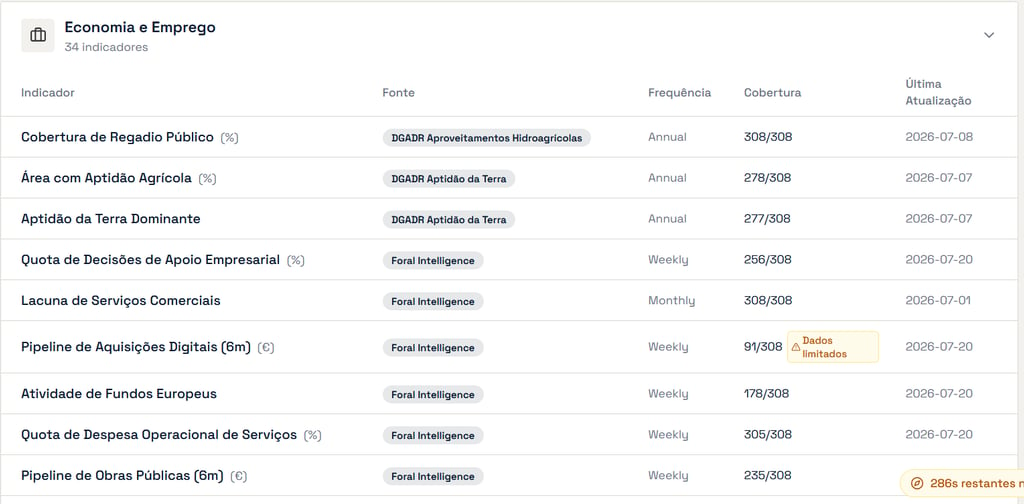
In our previous article, we explored Analisa.pt, a platform that demonstrated how Portuguese public data can be aggregated, connected, and explored in ways that go far beyond the experience offered by traditional government portals. By bringing together information from multiple public sources into a single interface, Analisa.pt showed that transparency is not simply about publishing data—it is about making that data searchable, comparable, and understandable.
Foral.ai builds on the same fundamental idea, but takes a different approach. Rather than focusing primarily on the analytical exploration of structured public datasets, it seeks to bring users closer to the day-to-day activity of local government through AI-powered document interpretation, continuous monitoring, and intelligent assistants.
Rather than replacing the vision introduced by Analisa.pt, Foral.ai represents another stage in the evolution of public intelligence platforms in Portugal.
From Data Exploration to Understanding Public Activity
Analisa.pt demonstrated that data from multiple public institutions can be consolidated into a single analytical environment. Public procurement, statistical indicators, territorial information, and institutional relationships become interconnected rather than existing as isolated datasets.
Foral.ai follows the same philosophy of aggregation but extends it into a different domain: the interpretation of administrative information generated daily by Portuguese municipalities.
Instead of answering only "What do the data reveal?", it also aims to answer "What happened today, and why does it matter?"
This seemingly small shift fundamentally changes the user experience. Information is no longer something users search for only when needed; it becomes something that can be continuously monitored and understood as events unfold.
Structured Data versus Administrative Documents
One of the most significant distinctions between the two platforms lies in the type of information they prioritize.
Analisa.pt focuses heavily on structured public datasets, allowing users to navigate statistical indicators, procurement contracts, organizations, municipalities, and the relationships between different entities. Interactive maps, network graphs, and advanced filtering capabilities help uncover patterns that would otherwise remain hidden across separate government databases.
Foral.ai, on the other hand, places much greater emphasis on administrative documentation itself. Municipal meeting minutes, official notices, resolutions, local news, and other administrative documents become searchable and interconnected within a single environment.
This distinction is important because much of the knowledge produced by public administrations still exists as documents rather than structured databases.
Artificial Intelligence as an Interpretation Layer
Both platforms leverage artificial intelligence, but for different purposes.
Within Analisa.pt, AI strengthens analytical exploration by making large collections of public information easier to navigate and connect.
Within Foral.ai, AI operates much closer to the original source material. The platform summarizes documents, identifies relevant events, extracts key decisions, organizes administrative information, and helps users quickly understand documentation that would otherwise require considerable time to read.
Rather than replacing official sources, AI acts as an interpretation layer between public administration and citizens.
From Search to Continuous Monitoring
Another important distinction concerns how users interact with the platforms.
Analisa.pt is primarily an exploratory environment. Users actively search, compare municipalities, investigate organizations, or analyze indicators and procurement data.
Foral.ai introduces a monitoring model. Through personalized alerts and continuous tracking of municipal activity, it keeps users informed whenever relevant events occur within a municipality, topic, or administrative process.
The result is a platform that functions less like a traditional search engine and more like an intelligence system continuously observing local government activity.
Bringing Citizens Closer to Public Administration
Another differentiating aspect of Foral.ai is its emphasis on civic engagement.
Beyond providing access to administrative information, the platform aims to reduce barriers between citizens and local government by supporting participation, simplifying access to municipal processes, and making administrative decisions easier to understand.
This reflects an evolution beyond conventional open data portals, where information is available but often disconnected from practical civic participation.
Complementary Approaches to Public Intelligence
It would be easy to describe Analisa.pt and Foral.ai as competitors. A more accurate interpretation is that they represent complementary approaches to the same challenge.
Analisa.pt excels at analytical exploration, helping users discover relationships within structured public data and generate insights from multiple official sources.
Foral.ai focuses on interpreting administrative documents, continuously monitoring municipal activity, and using artificial intelligence to transform complex public information into accessible knowledge.
Both platforms pursue the same objective: reducing the distance between public information and the people who need it.
The Future of Public Intelligence
Governments already generate enormous amounts of public information. The challenge is no longer simply publishing more data, but organizing it, contextualizing it, and making it genuinely useful.
Platforms such as Analisa.pt and Foral.ai illustrate how artificial intelligence can become an enabling layer for transparency rather than merely an automation tool.
If the first generation of transparency initiatives focused on publishing datasets, this new generation is focused on creating genuine public intelligence platforms—systems capable of helping citizens, businesses, researchers, journalists, and policymakers understand what governments are doing, why those actions matter, and how they affect society.
The real value no longer lies in the volume of available information. It lies in the ability to interpret it, connect it, and deliver it at the right moment, strengthening transparency, democratic accountability, and informed civic participation.
Backed by Thendor
Testbed and business expansion
Phone
nuno.amiar@umaboaquestao.pt
+351-91-293-1493


Socials
Contacts
Built in the open for the public good. We invite civic innovators, technologists, and policymakers to collaborate and innovate together