
The Council of the Commons
A Permanent Infrastructure for Democratic Attention
7/20/20265 min read
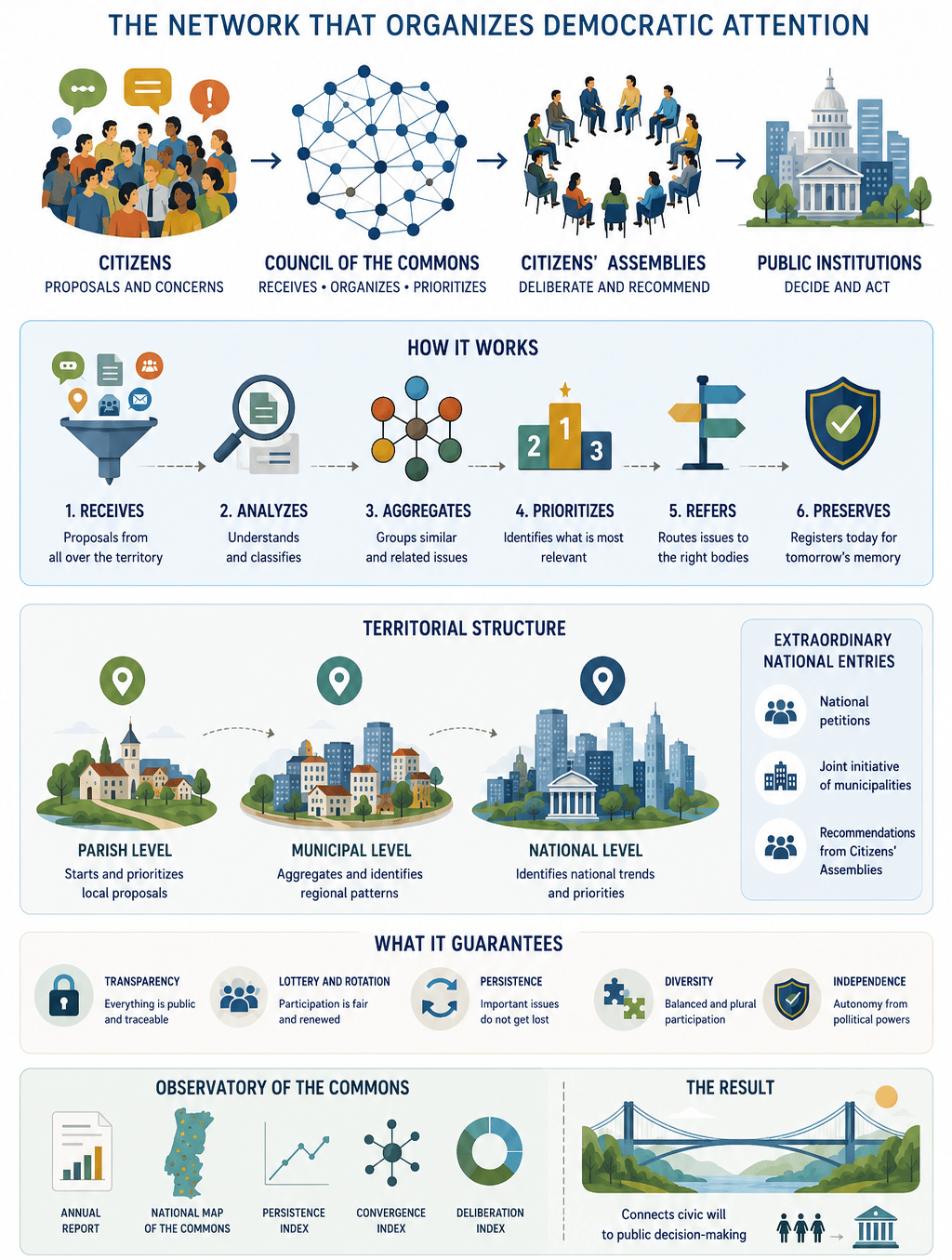

To: The Government of Portugal, the Assembly of the Republic, the National Association of Portuguese Municipalities, the National Association of Civil Parishes, and all citizens of Portugal
To all those committed to strengthening democracy in Portugal,
The undersigned citizens hereby call for the establishment of the Council of the Commons as a permanent democratic infrastructure dedicated to identifying, organizing, preserving and forwarding the collective concerns expressed by society.
Statement of Purpose
Contemporary democracies possess representative institutions and a wide variety of participatory mechanisms, including petitions, public consultations, digital participation platforms, civic movements, associations, local initiatives and Citizens' Assemblies.
Yet a structural gap remains.
Modern democracies possess no permanent institution dedicated to continuously observing, organizing, interpreting and preserving the signals produced by society itself.
Citizens' concerns often emerge in fragmented, dispersed and temporary forms. Public attention shifts rapidly towards new issues, while persistent, cross-cutting and structurally important concerns frequently disappear from institutional attention before they can be adequately understood or addressed.
For this reason, Portugal should establish a permanent institution devoted to organizing democratic attention and preserving democratic memory.
What is the Council of the Commons?
The Council of the Commons is a permanent democratic infrastructure whose mission is to:
receive proposals concerning the public interest;
register them;
classify them;
aggregate related concerns;
prioritize issues of collective relevance;
refer them to appropriate deliberative mechanisms and public institutions;
preserve them as part of the country's democratic memory.
The Council of the Commons is not:
a parliament;
a government;
a court;
a Citizens' Assembly;
a constitutional body;
a legislative institution;
an executive institution;
a judicial institution.
It exercises no legislative, executive or judicial authority.
It does not replace any existing democratic institution.
Its sole function is to ensure that no democratically relevant signal disappears simply because society lacks the institutional capacity to observe, organize or remember it.
Fundamental Principles
The Council exists to:
identify matters of public concern;
aggregate dispersed concerns;
prioritize issues of collective significance;
generate agenda proposals for democratic deliberation;
organize collective attention;
preserve democratic memory.
It does not exist to govern, legislate, represent or deliberate in place of existing institutions.
The Council answers one question:
"What should we deliberate about?"
It does not answer:
"What should we do?"
Territorial Organization
The system operates through three territorial levels.
Parish Level
Responsibilities include:
receiving proposals;
initial registration;
local aggregation;
local prioritization;
formulation of local agenda proposals.
This constitutes the principal entry point into the system.
Initiatives may originate from:
individual citizens;
groups of citizens;
petitions;
digital platforms;
associations;
informal civic movements;
the Parish Council of the Commons itself.
Municipal Level
Responsibilities include:
aggregating proposals received from parishes;
identifying territorial patterns;
municipal prioritization;
referral to higher levels.
The municipal level possesses no independent agenda-setting power.
Its role is exclusively interpretative.
Its central question is:
"What patterns exist across this municipality?"
It does not create policy.
It does not create new issues.
It produces territorial intelligibility.
National Level
Responsibilities include:
national aggregation;
identification of systemic trends;
preparation of national reports;
referral to Citizens' Assemblies and competent public institutions.
The national level possesses no independent initiative.
Its role is exclusively interpretative.
Its guiding question is:
"What patterns exist across the country?"
It neither creates policy nor generates political agendas.
It produces national intelligibility.
Extraordinary National Entries
A proposal may directly enter the national level whenever it originates from:
a national petition reaching a qualified threshold;
a joint initiative supported by a minimum number of municipalities;
a recommendation adopted by a Citizens' Assembly.
These mechanisms allow nationally significant issues to enter the system without depending exclusively on ordinary territorial progression.
Relationship with Citizens' Assemblies
The Council of the Commons and Citizens' Assemblies perform complementary but distinct functions.
Citizens' Assemblies answer:
"What should we do?"
The Council of the Commons answers:
"What should we deliberate about?"
Citizens' Assemblies produce recommendations.
The Council produces organized democratic attention and agenda proposals.
It neither replaces nor constrains the autonomy of Citizens' Assemblies.
Public Register of the Commons
Every proposal is permanently recorded within a public, auditable register.
Each proposal retains:
its origin;
its history;
related aggregations;
priority status;
associated deliberations;
current status.
A proposal may be:
under review;
aggregated;
prioritized;
referred;
deliberated;
archived;
reactivated.
No proposal is ever deleted.
The Register constitutes the central element of the system.
It guarantees:
democratic memory;
traceability;
institutional continuity.
Members rotate.
The Register remains.
Prioritization Criteria
Prioritization shall consider, cumulatively:
intensity of public support;
persistence over time;
territorial recurrence;
systemic impact;
overall balance of the public agenda.
Issues that repeatedly emerge across multiple years and territories should progressively acquire greater democratic significance, regardless of temporary media visibility.
Diversity of the Public Agenda
To reduce agenda capture and excessive concentration of public attention, the agenda shall consist of:
60% issues selected according to public relevance;
20% issues selected according to historical persistence;
20% issues selected by civic lottery among eligible proposals.
Observatory of the Commons
The system includes a permanent democratic observatory responsible for producing:
Annual Report of the Commons;
National Map of the Commons;
Democratic Persistence Index;
Territorial Convergence Index;
Effective Deliberation Index.
The Observatory shall also monitor:
recurring petitions;
repeated recommendations;
persistent public problems;
territorial divergences;
issues lacking institutional response.
Its Annual Report shall identify:
emerging issues;
persistent issues;
territorial distribution of public concerns;
historical evolution of issues;
recurring matters that remain institutionally unresolved.
Permanent Operation
Principle of Permanence
The Council of the Commons is a permanent democratic infrastructure operating continuously.
Its activity is independent of electoral cycles, parliamentary terms, governments or exceptional convocations.
The system remains permanently active at every territorial level, continuously receiving, observing, registering, aggregating, prioritizing and preserving proposals concerning the public interest.
Such continuity is essential for preserving democratic memory and identifying long-term patterns within collective concerns.
Civic Composition
Members of the Council shall be selected through civic sortition.
The selection process shall ensure:
randomness;
statistical representativeness;
territorial diversity;
social diversity;
demographic diversity;
corrective mechanisms addressing under-representation.
No individual member possesses unilateral decision-making or veto power.
Participation constitutes a temporary civic responsibility performed in the public interest.
Selection of Participants
Participants shall serve in successive, non-overlapping terms.
Selection shall occur through transparent, publicly auditable and traceable civic lottery procedures based upon legally established civic registers.
Every participant shall receive clear information concerning:
the nature and purpose of the Council;
duration of service;
rights and responsibilities;
operating procedures;
guarantees of independence and transparency.
Continuous Renewal
Membership shall rotate periodically through a system of continuous renewal.
Rotation shall ensure simultaneously:
regular entry of new participants;
preservation of institutional knowledge;
operational continuity;
uninterrupted functioning.
Immediate consecutive reappointment shall not be permitted.
Institutional Continuity
Members rotate.
Working groups evolve.
Public priorities change.
Proposals may be aggregated, archived or reactivated.
The institution itself remains.
The Public Register of the Commons preserves continuity, traceability and democratic memory, ensuring that no collectively relevant concern disappears over time.
The Council of the Commons is not an occasional assembly convened to solve isolated problems.
It is a permanent infrastructure of democratic attention designed to preserve, organize and transmit the continuity of the democratic conversation across generations.
Historical Significance
The Council of the Commons constitutes an institution of democratic memory, democratic attention and civic coordination.
Citizens generate signals.
Citizens' Assemblies generate deliberation.
Public institutions generate decisions.
The Council of the Commons ensures that relevant democratic signals reach the places where deliberation and decision can occur.
It is not an institution of power.
It is an institution of attention.
It is not an institution of government.
It is an institution of democratic memory.
Its value lies not in exercising political authority but in making visible what society persistently seeks to express over time.
It constitutes a permanent order of observation, aggregation and transmission of civic concerns and may be understood as the nervous system of deliberative democracy, ensuring continuity between citizens, democratic deliberation and public decision-making.
Final Request
The undersigned respectfully request that the Assembly of the Republic promote the establishment of the Council of the Commons as a permanent democratic infrastructure responsible for observing, aggregating, prioritizing, referring and preserving civic concerns, thereby strengthening the capacity of Portugal's democratic system to listen, understand and remember the collective concerns of society and ensuring that no democratically relevant signal is lost over time.
LINK TO PETITION: https://peticaopublica.com/pview.aspx?pi=PT131512
Backed by Thendor
Testbed and business expansion
Phone
nuno.amiar@umaboaquestao.pt
+351-91-293-1493


Socials
Contacts
Built in the open for the public good. We invite civic innovators, technologists, and policymakers to collaborate and innovate together

